
Afterimage, Part III

Previous Chapters:
VII. The Letter
Sawatari wrote the letter to Yokoyama. He did not know the man’s email address. He was not even certain a former war photographer in his eighties would have one. He bought stationery instead. Buying stationery at a Las Vegas drugstore carried a strange sense of displacement. Greeting cards occupied most of the aisle. Birthday balloons. Sympathy cards. Glittered congratulations for graduations and retirements. Near the bottom shelf sat a single stack of plain white lined paper wedged between Christmas cards and discounted Valentine envelopes. The envelopes were sold separately.
He stood there longer than necessary.
The fluorescent lights buzzed overhead. Somewhere near the pharmacy counter a child was crying continuously in short exhausted bursts. An elderly man coughed wetly into a handkerchief while comparing prices on vitamins.
Sawatari picked up the stationery finally because there was nothing else to do.
Outside, the automatic doors opened onto dry Nevada heat. Even in February the sunlight carried weight. The asphalt parking lot shimmered faintly beneath rows of trucks and faded sedans. Palm trees leaned above the storefronts looking decorative rather than alive.
Back home he sat at the kitchen counter with the paper in front of him for nearly twenty minutes before writing anything. The refrigerator hummed. The air conditioning clicked on and off. Emma was upstairs watching something loudly through headphones. The ceiling occasionally creaked beneath her movement.
Sawatari wrote:
I did not know my father had gone to Vietnam. He stopped there. That part at least was true. He had not known. Or rather he had not known because nobody had spoken, and because he himself had accepted the silence as structural, which was not quite the same thing as ignorance although it resembled it from the outside, and perhaps all families eventually became systems for preserving mutually agreed absences, maintaining them carefully generation after generation until the absences hardened into personality.
He stared at the sentence. Forty years. More than forty years. His father had crossed an ocean and entered a war and returned again before Sawatari was born, and somehow this had vanished completely from family life afterward. Not hidden exactly. Hidden implied intention. This was something else. A fact allowed to dry out quietly until it became weightless.
He wrote again.
What kind of person was my father?
The question looked embarrassing immediately.
Fifty-five years old and asking strangers to explain his own father to him. Still he left it there. Because asking family would be worse. His brother would say: He was a normal old man. His mother would say: Your father was your father. That was how Japanese families often protected themselves. Repetition in place of explanation. Roles instead of disclosures. Father. Mother. Son. The labels stabilized things. Once fixed, they resisted revision. Inside the family his father had long ago solidified into a single shared image. Quiet. Difficult to understand. A man who wandered from room to room without apparent purpose. Everybody agreed upon this version. Sawatari himself had agreed upon it for decades. Perhaps that was why conversation with his father had always collapsed so quickly. The role had already been assigned. Nothing new could enter it.
He folded the letter slowly. The paper felt thin in his hands.
At the post office he bought international stamps and dropped the envelope into the outgoing mail slot. The moment it disappeared he regretted sending it. Not dramatic regret. Administrative regret. The feeling of having initiated a process impossible to retrieve. Driving home along Flamingo Road he kept imagining replies. Maybe Yokoyama would never answer. Maybe the old man was already dead and the camera had been mailed by relatives clearing out an apartment. Or worse: Maybe Yokoyama would answer honestly. Your father drank heavily. Your father hated his life. Your father talked constantly when away from family. Specificity frightened Sawatari more than grief.
At home the Nikon remained on the kitchen counter. Late afternoon sunlight entered through the blinds in thin horizontal bars. Dust moved through them slowly. The camera’s cracked lens reflected fractured copies of the room.
Without deciding to, Sawatari picked it up. He looked through the finder. At first he saw only the kitchen. Countertop. Microwave. Emma’s backpack near the pantry door. Then another structure began surfacing beneath it. Tatami grain. The faint rectangular outline of fusuma frames beneath drywall. Weak yellow light moving through old shōji paper. The Matsudo house. Not memory exactly. Memory carried softness around the edges. This felt harder than memory. More architectural. As though another house continued existing beneath the visible one, occupying identical coordinates from some slightly displaced layer of time.
He lowered the camera. The kitchen returned immediately. Then he raised it again. Now the overlap had deepened. Where the pantry should have been stood the narrow hallway from the Matsudo house. He could almost smell dust and old paper. Somewhere deeper inside the house a television murmured indistinctly. Baseball perhaps. Or NHK evening news.
Then he saw his father. Only his back. White short-sleeved shirt. Shoulders slightly bent. Walking away down the hallway exactly as he had during Sawatari’s childhood. Never toward anyone. Always away.
Sawatari lowered the camera sharply. His chest felt cold. Not metaphorically cold. Physical coldness beneath the ribs. Upstairs Emma laughed suddenly at something on her tablet and the ordinary sound stabilized the room again.
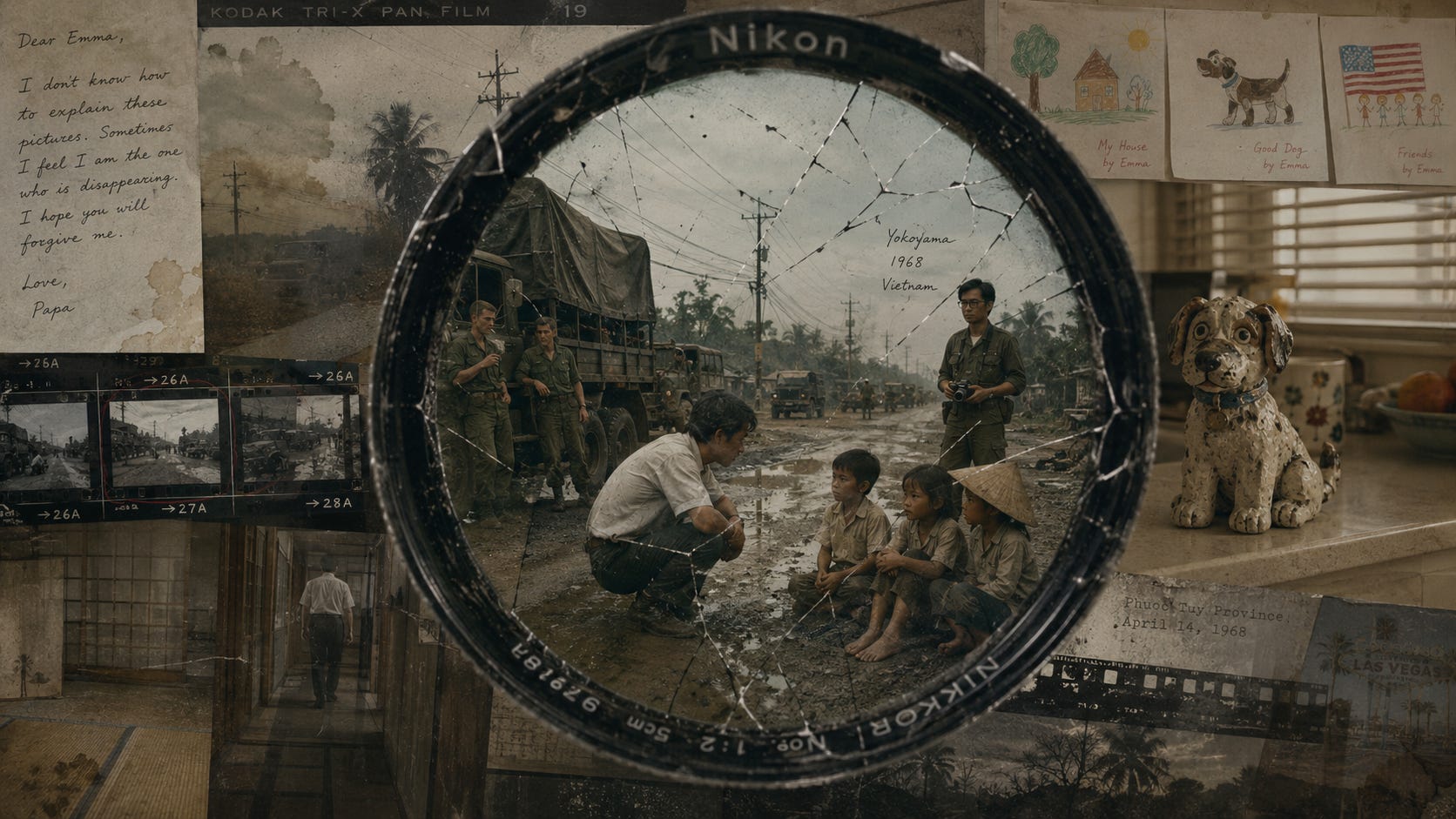
That night he looked through the finder once more. Then again the following night. And again after that. The landscapes inside the camera alternated between Matsudo and Vietnam. The Matsudo house appeared dim and quiet. Hallways. Closets. Weak daylight trapped behind curtains. His father moving endlessly from room to room without destination. Vietnam appeared differently. Brightness. Humidity. Standing water reflecting pale sky. Young soldiers smoking beside trucks. Electrical wires sagging above muddy roads. And always Yokoyama somewhere nearby holding the camera.
One night Sawatari saw his father walking beside Yokoyama along a roadside path. His father looked impossibly young. Thinner than Sawatari remembered any adult ever being. Black hair falling slightly over his forehead. Cigarette in one hand. White shirt darkened beneath the arms from sweat. The two men were not speaking. Or perhaps they had already finished speaking. The silence between them did not resemble the silence of the Matsudo house. It lacked heaviness. This silence seemed provisional. Temporary shelter between noises. Then the image shifted. Three Vietnamese children sat beside the road. His father crouched in front of them. Yokoyama stood several feet behind holding the camera. For a long moment nothing happened. The children stared at his father curiously. His father said something. Or perhaps not. Sawatari could not tell through the fractured silence of the viewfinder whether words were actually being exchanged or whether his mind merely expected them. His father had always been awkward even in Japanese. The idea of him attempting conversation in a country where he barely knew the language produced a strange pressure inside Sawatari’s chest. He did not want to sentimentalize it. He did not want to transform the scene into one of those stories people told themselves about human connection transcending language. Language did not disappear simply because emotion wanted it to. Absence remained absence.
And yet his father stayed there crouching before the children. Not speaking. Not leaving. Present in some incomplete but undeniable way. Sawatari realized with discomfort that the figure before him did not resemble either version of his father he carried inside himself. Not the silent father from Matsudo. Not the dead father from the funeral photograph. Something else. A third father. A man existing briefly outside the family structure that had later sealed around him. The image remained visible for several seconds more. Then the finder clouded slightly as though humidity had entered the camera from inside. The Vietnamese road dissolved gradually into cracks of light across the damaged lens. Sawatari lowered the Nikon. His hands smelled faintly of metal afterward. Or perhaps old rain.
VIII. Parents’ Day
Emma’s school held Parents’ Day on a Friday. Kelly said she could not move her shift, so Sawatari went instead. Kelly worked administrative intake at a medical office now. Scheduling. Insurance verification. Billing disputes. Her shifts probably really were impossible to move. Still, even if they had been flexible, it likely would have been Sawatari attending anyway. Parents’ Day required only one parent. Kelly said,
“You’ve been less busy lately anyway.”
Less busy meant he had stopped staying late at work. Not because work had improved. Because he had started avoiding the office deliberately.
He preferred getting home early now. Preferred the late-afternoon silence of the house before Kelly returned. Preferred sitting at the kitchen table with the Nikon nearby, sometimes without even touching it, merely aware of its presence inside the room the way one remained aware of another person breathing in darkness. He understood this already. Understanding and admitting were different operations.
The school sat twenty minutes away near Summerlin. Artificial grass fields. White concrete buildings. Rows of thin decorative trees staked upright against desert wind. Parents moved through the hallways carrying paper coffee cups and wearing the strained friendliness specific to middle-class American school functions. Expensive sneakers. Fitness watches. Company-logo fleeces from tech firms and hospitals.
Sawatari wore the same gray button-up shirt he used for Zoom meetings. The event consisted of three stages. First the parents walked around the classroom examining student projects taped to walls and shelves. Then brief conversations with the teacher. Then informal conversation among parents. Sawatari disliked all three. Especially the third. The classroom smelled faintly of dry-erase markers, glue, and the sweet dusty odor elementary schools everywhere seemed to share regardless of country. Children’s drawings covered one wall in uneven rows. Construction-paper planets. Family portraits. Lists of favorite foods written in careful oversized handwriting.
Emma waved at him from across the room. Not enthusiastically. At eleven children began managing affection publicly. Her hair remained slightly tangled despite Kelly brushing it every morning. One shoelace had already come loose.
“Hi,” she said.
“Hi.”
“You came.”
“Looks that way.”
She nodded seriously, as though attendance itself constituted accomplishment. Then she drifted immediately back toward friends.
Sawatari stood examining a display of student essays about future careers. Veterinarian. YouTuber. Marine biologist. Professional soccer player. One child wanted to own a reptile sanctuary in Arizona. Emma’s paper read: Maybe artist maybe veterinarian maybe something else. He stared at the sentence longer than necessary. Something else. At her age possibilities still existed in plural form. An American mother seated beside him asked: “So what do you do?” Sawatari answered automatically. “Software engineer.” In Las Vegas this was usually a safe response. Technology work carried enough prestige to discourage further curiosity while sounding sufficiently boring to end conversations naturally. But this woman smiled with genuine interest. “Oh, interesting. What kind of software?”“Backend payment systems.” The effect was immediate. Interest dimmed politely behind her eyes. “Wow,” she said after a small pause. “That sounds complicated.”Complicated meant conversation concluded successfully. Sawatari nodded. He imagined instead saying: I write novels. Not wrote. Write. Present tense. He imagined the brief silence afterward. The slight recalibration people performed internally when encountering artistic ambition in middle-aged adults. Admiration mixed uneasily with concern. Then eventually: “That’s wonderful.” Wonderful in exactly the tone his mother once used when asking whether he still wasted time on “those stories.” He could almost feel the muscles in his face preparing themselves for the old embarrassment. The strange thing was that he no longer wrote novels. Had not written seriously in years. Yet the shame remained active inside him as though the unwritten books continued existing somewhere nearby waiting resentfully in darkness. The teacher approached eventually. Young. Exhausted-looking. Hair tied back too tightly.“Emma’s very creative,” she said. Creative. Teachers used the word carefully around objects they could not classify. Emma’s project sat on a low shelf near the windows. A clay animal. Supposedly a dog. Its neck was too long. Its legs too short. The face carried an oddly human uncertainty around the eyes. One ear drooped lower than the other as though melting slightly. “What kind of dog is it?” Sawatari asked later. Emma shrugged.“Just dog.” The teacher smiled diplomatically. “She has a very original visual imagination.”Original visual imagination. The American educational system generated elaborate phrases for confusion. Sawatari thanked her anyway. He noticed suddenly that several parents nearby were discussing after-school enrichment programs with visible anxiety. Robotics camps. Debate coaching. Advanced placement preparation already beginning for children barely out of elementary school. One father spoke about Stanford admissions as though describing military logistics. Sawatari felt tired immediately. Not morally tired. Structurally tired. As though adulthood consisted largely of standing in fluorescent rooms pretending future control remained possible.
When the event finally ended Emma climbed into the passenger seat carrying the clay dog carefully in both hands. The interior of the Camry had become hot beneath the afternoon sun. Air conditioning blasted dry cold air through the vents while Emma adjusted the clay figure repeatedly to keep it upright. Traffic moved slowly through school pickup lanes. SUVs. Teslas. A pickup truck with faded Punisher decals. Nobody looked at one another directly. At a red light Sawatari glanced into the rearview mirror. The clay dog had fallen onto its side across the back seat. Its long neck bent awkwardly against the upholstery. Behind it, headlights from the car behind them reflected briefly through the rear window. For a moment the light struck the clay animal’s glazed eye and produced the distinct impression of awareness. Not movement. Only reflected presence. Still, something tightened unpleasantly beneath Sawatari’s ribs. He looked away immediately. Outside the windshield the Nevada sky remained enormous and pale above rows of beige commercial buildings. Emma was saying something about soccer practice. Sawatari realized he had not heard any of it. “Sorry,” he said. “What?” Emma repeated herself patiently. Children repeated themselves for distracted adults with the resigned tolerance of nurses. As they drove westward the late-afternoon light softened slightly. Mountains appeared beyond the subdivision roofs in muted purple layers. For several minutes Las Vegas became temporarily beautiful in the exhausted way it sometimes did near sunset, when shadows finally returned and the city almost resembled a place built for living rather than endurance.
At home Emma carried the clay dog carefully inside. Sawatari remained seated in the driveway a few seconds longer than necessary with the engine off. The Nikon waited somewhere inside the house. He could already feel its presence there. Not supernatural. More mechanical than that. Like an unfinished process still running silently in the background of a system long after the user believed the application closed.
IX. Yokoyama’s Reply
The reply arrived two weeks later. The envelope was thin. Japanese stamps. Careful handwriting. Slightly uneven pressure from an old fountain pen. Sawatari recognized the angular script immediately. Not elegant handwriting. Severe handwriting. Characters built from straight lines and hesitation. Three sheets of paper. Numbered properly in the upper corner. That detail disturbed him more than it should have. People from his father’s generation trusted numbering systems. Ordered pages against disappearance. Against accidental loss. As though disorder itself might permanently damage meaning. Sawatari stood in the kitchen holding the envelope for several seconds before opening it. Outside, late afternoon light flattened the subdivision into pale geometry. A landscaping crew somewhere farther down the street operated leaf blowers in synchronized waves. The sound rose and fell mechanically through the neighborhood like industrial surf. Emma was upstairs. Kelly would not be home for another hour. The house existed in its in-between condition. Not empty. Not occupied. Appliances continuing their private labor in silence. He sat at the kitchen table and unfolded the first page.
I have read your letter. You ask what kind of man your father was. Unfortunately I do not know very much. We met in Saigon during the summer of 1968.
We had no mutual acquaintances. To be honest, I no longer remember clearly how we began speaking. Your father happened to sit beside me at a small restaurant near the hotel district.
Sawatari stopped reading briefly. Saigon. The word itself felt implausible attached to his father. His father belonged to smaller words. Ashtrays. Train schedules. Whisky glasses. The weather report. Not Saigon. He continued.
Your father was an unusual man. While I photographed people and streets, he stood quietly nearby without interfering. Officially he accompanied me as an interpreter, though in truth his English and Vietnamese were both limited.
Even so, his presence proved useful. Local people did not become cautious around him. Not because he spoke well. He was simply very good at being there quietly.
Sawatari read the sentence twice. Very good at being there quietly. The phrasing carried neither admiration nor criticism. Merely observation. Yet something inside the sentence unsettled him deeply. All his life his father’s silence had existed inside the family as deficiency. Failure of communication. Emotional absence. Something exhausting everyone around him gradually without visible aggression.But outside the family, in another country decades earlier, the same silence had apparently transformed into usefulness. A different system. A different reading. He continued reading.
Only once did your father attempt to borrow my camera. I do not know what he intended to photograph. Perhaps children. I remember several children seated beside a roadside. Your father stopped walking. For a long moment he simply stood there with the camera raised. But the shutter never released. I do not believe the camera malfunctioned. Rather, I think your father’s finger stopped moving. There are people who freeze before the thing they most wish to capture. Your father was that kind of person.
Sawatari lowered the letter slowly. The refrigerator hummed behind him. A car door slammed somewhere outside. The air conditioning turned on with a soft internal shudder. He stared at the tabletop without fully seeing it.
There are people who freeze before the thing they most wish to capture. Not poetic language. Not metaphor. Technical language almost. As though describing a mechanical fault occurring repeatedly under specific emotional conditions. He continued.
When I returned to Japan, I gave your father the camera. By then I had already purchased newer equipment. Your father was not a photographer, but he seemed to care for the camera carefully. Afterward I received letters from him several times a year.
The letters did not discuss photography. Nor did they discuss family. Mostly weather. The neighborhood. Seasonal changes. This continued for many years.
Sawatari felt an unpleasant pressure behind his eyes. His father had written letters for decades to a man the family never mentioned. Not hidden exactly. Merely never spoken aloud. That was different.
Entire parallel structures had apparently existed beside family life all along. Small sustained exchanges invisible from inside the household. Weather reports crossing oceans. Seasonal observations. Quiet continuations.
He imagined his father late at night at the kitchen table in Matsudo writing about rain. About humidity. About nearby construction. Never mentioning wife or sons. Never mentioning unhappiness either. A private correspondence built entirely from surfaces. And yet somehow maintained faithfully for decades.
The final page was shortest.
I never asked why your father was in Vietnam.
Or rather, I could not ask.
Your father possessed a kind of silence that did not permit questions.
Sawatari finished reading.
Then read the letter again from the beginning.
Outside, the landscaping crew had moved farther away. The sound of leaf blowers faded gradually street by street through the subdivision.
By the third reading the sunlight had shifted completely across the kitchen floor.
On the fourth reading he realized tears had fallen onto the paper.
Only then did he understand he was crying.
Not dramatic crying.
No sound.
Only water accumulating silently until the ink blurred slightly near the bottom edge of the second page.
Sawatari was not a man who cried.
He had not cried during his father’s funeral seven years earlier. He remembered standing beside relatives in black suits beneath weak winter sunlight outside the crematorium while everyone else performed grief at socially recognizable volume. He remembered feeling mostly administrative exhaustion. Train schedules. Condolence rituals. Tea growing cold in paper cups. He had not been ashamed then. People mourned differently. That was what he told himself afterward.
But now, sitting alone in a Las Vegas kitchen reading the angular handwriting of an old photographer, tears continued falling onto the numbered pages.
There are people who freeze before the thing they most wish to capture.
The sentence remained inside him physically. Not emotionally. Like cold metal lodged beneath the ribs. And then, without wanting to, he remembered the day he stopped writing. Not the exact date. The body rarely preserved dates accurately. Only textures. Winter light. Cheap coffee gone cold. The weak smell of cigarette smoke trapped in curtains. A Tokyo apartment small enough that the heater clicked loudly each time it activated. He had been twenty-eight perhaps. Or twenty-nine. Manuscript paper spread across the desk. A fountain pen in his hand. He remembered sitting there for nearly three hours without writing a single character. The strange thing was that he had wanted to write. The desire existed fully. Scenes. Sentences. Images. All present internally. But the movement itself would not occur. His hand remained suspended above the paper. Not paralysis exactly. More specific than paralysis. A stoppage between intention and execution. At the time he told himself it was exhaustion. Then distraction. Then temporary depression. After enough years passed he stopped explaining it entirely. He simply became someone who used to write. Now, reading Yokoyama’s letter, another possibility emerged. His father standing beside a Vietnamese road unable to release the shutter. Sawatari seated before manuscript paper unable to lower the pen. The same failure occurring through different machinery. For several minutes he remained motionless at the kitchen table. The Nikon sat nearby beneath the weak fluorescent light. The cracked lens reflected fragmented copies of the room. Then suddenly he understood something else. His father had carried the camera home anyway. Even after failing to take the photograph. That part mattered too.
TO BE CONTINUED IN PART IV