
Room 3327, January
Somnium Teslae: Circuitus Sine Auctore

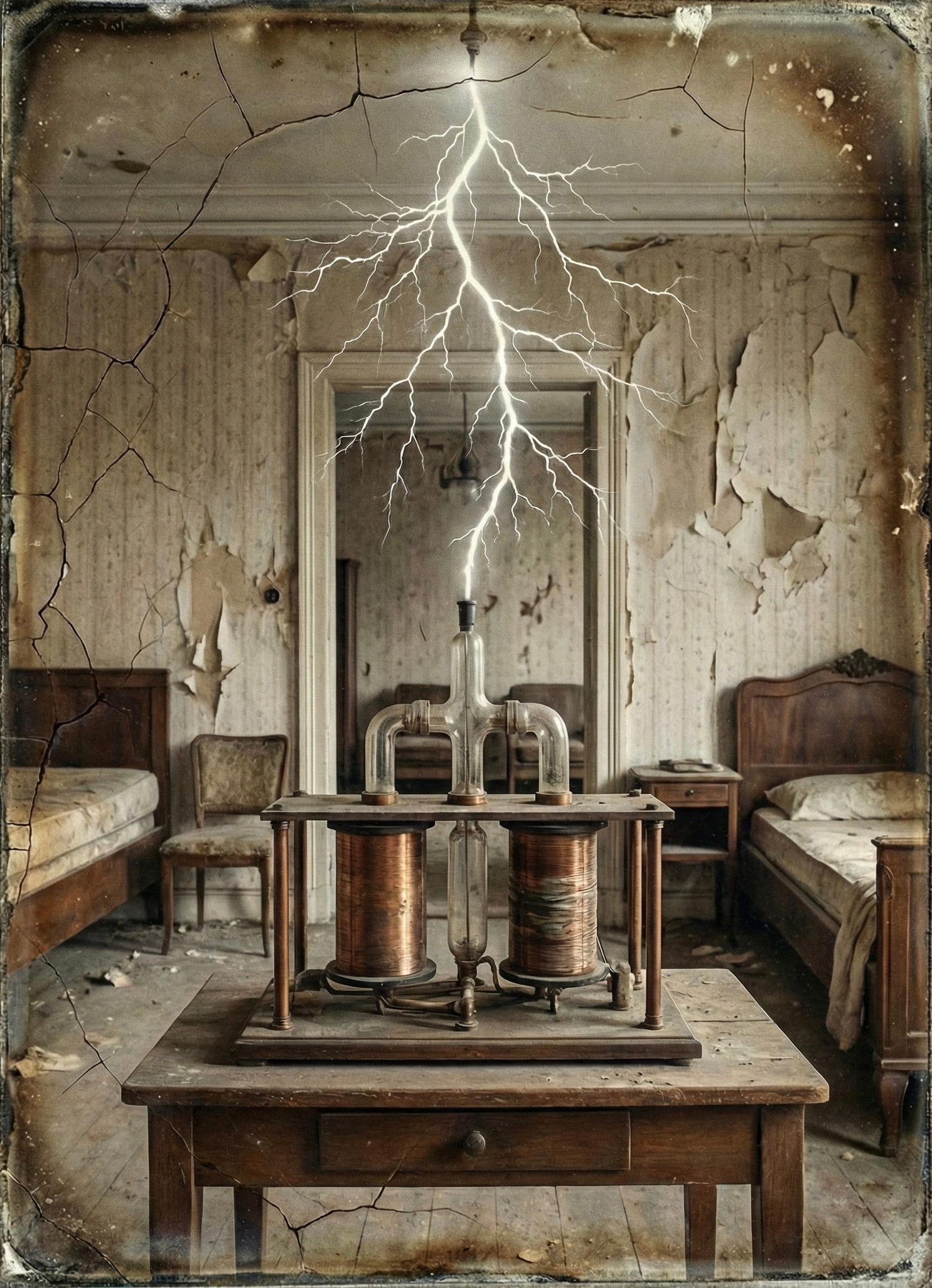
Prelude — Room 3327 / Night
Room 3327. The number does not speak, it stoji—stands—like a nail driven flush, neither proud nor hidden. A mark is enough. The door closes. The hotel continues its long vertical breathing. Pipes murmur. Lifts ascend and descend with a patience I once admired in machines and later learned to admire in men only rarely. Night has entered without knocking. Sedmi januar, devetnaest stotina četrdeset i treća. The date exists because the calendar insists; the room does not ask for it.
I lie upon the bed, clothed. Navika—habit—stronger than intention. The body has reached šest i osamdeset godina, and it reports this fact without commentary. Breath arrives as if fetched from a greater distance than before. It pauses, as though consulting a račun—a ledger—then departs. There is a weight behind the sternum, steady, pristojan—courteous—neither a knife nor a warning bell. The heart performs its work without ornament, as engines do when spectacle is no longer required of them.
The bed holds its rectangle. Linen drawn tight, corners disciplined. The table stands near, faithful. Papers lie aligned, not because disorder offends me—chaos has its mathematics—but because order permits legibility. Ink rests on paper as talog—sediment—left by thought, not as thought itself. The radiator ticks, metal speaking to metal, counting without knowing what it counts. The lamp remains lit, subdued; light here is dopuštenje—permission—not revelation. The window prefers reflection. It gives me back the room more readily than it offers the city.
Beyond the wall, systems persist. Elevators rise. Current redistributes. Lamps in other rooms hold their glow. The grid proceeds without sentiment. A good system does not remember its maker; it remembers only its zakon—law. I learned this early and trusted it more than gratitude.
My mind does not advance. It kruži—it circles. Not because I will it so, but because circling is what remains when direction has been exhausted. Thought returns upon itself the way current returns in alternating motion—gubitak i povratak—loss and return—each necessary, neither tragic. Sequence loosens. Time becomes porous.
Golubovi—pigeons—enter without crossing the threshold. They are not here, and yet they are. The hand remembers grain, the small pressure of life trusting weight to bone. A bird returns because return is its zakon. There is no metaphor demanded. The fact is dovoljna—sufficient. Attention once given establishes its own economy; it does not require applause.
Hotels assemble themselves without chronology. Sobe—rooms—similar in measure, different in number. Corridors learned, relearned. Dolazak, boravak, odlazak—arrival, stay, departure. Repetition does not equal loneliness. Samoća—solitude—is not absence; it is containment. Containment allows misao—thought—to remain gathered.
The papers wait. They do not accuse. They do not beg. They are dokaz—evidence—that thought once required surface and was granted it. Calculations set down because the mind, though precise, is konačna—finite. Precision, left unrecorded, evaporates. The papers do not look back. They are not icons; they are deposits.
The city persists as function. Traffic reduces to vibration. Voices attenuate into hum. The grid behaves. Somewhere a switch closes. Somewhere a transformer accepts load. Somewhere a window brightens because a hand has chosen light. None of this is događaj—event. It is stanje—condition. Condition does not need witness.
The pressure in the chest gathers slightly, then steadies. It does not argue. Breath enters, pauses, leaves. The pause lengthens by increments too small for anyone untrained to notice. I notice. Not with fear. Alarm belongs to hitnost—urgency—and urgency has thinned over years into something like dust.
Thought releases its grip on order. Years refuse to stand in line. Images appear without apology. A folded letter becomes hinge rather than object. Water falling becomes current without passing through decades. One room resembles another without explanation. I observe my own mind as I once observed machines nearing rest: fewer corrections, longer intervals, diminishing friction.
Light does not change. The lamp does not flicker. The window does not darken. The room keeps its proportions with the indifference of geometry. The city does not respond, and this is correct. A system that responds to sentiment is not yet complete.
No final image asserts itself. No rečenica—sentence—assembles to close the matter. The current does not cease; it usporava—it slows. The slowing is tehničko—technical—not dramatic. A circuit easing toward ravnoteža—equilibrium—after long service.
Room 3327 keeps its number. The night keeps its tišina—stillness. The world beyond the wall continues its operations evenly, without appeal, without interruption, while within this room motion contracts to the smallest necessary measure, and stillness settles—not as presuda—judgment—not as završetak—ending—but as stanje, accepted, finally, without need of translation.
Part I — Arrival / Current
The room does not depart when the mind goes elsewhere. Room 3327 remains, its angles intact, its light unchanged. Yet another city overlays this one—not brighter, not louder, only earlier, as if the present had allowed a thin underlayer to show through. I do not leave; I return. Povratak—return—is the gentlest motion.
1884. The date fixes itself like a pin through paper. A young man enters New York. I enter. There is little money. That is not a posture; it is arithmetic. Enough to stand, not enough to delay. In the pocket, a folded letter, ink still obedient to its lines, addressed to a man whose name the city already knows. The letter offers access, not understanding. Papir can open a door; it cannot open a mind.
The city does not acknowledge arrival. Streets carry weight without pause. Gaslight trembles. Wires extend and stop. Energy refuses distance, bleeds away, behaves as if offended by travel. I observe this immediately—not with irritation, but with the calm that comes when a structure reveals its limit. Limit is not sin. It is information.
Work arrives before explanation. Employment precedes alignment. Machines are adjusted. Dynamos corrected. Faults identified and removed with speed that does not seek applause. The work answers to law, not to temperament. I assume—razumno, I think—that what functions better will replace what functions poorly. This assumption holds only when other forces do not interfere.
Direct current presents itself plainly: short reach, steady loss, insistence upon obedience. Alternating current reveals another character altogether: reversal that continues, loss that returns, motion sustained by change rather than halted by it. This is not persuasion. It is geometry. One need not argue with a circle to show that it closes.
Departure follows. Not exile. Not quarrel. A subtraction. The arrangement ceases. The work ends because the terms end. The body enters another register. Ditches are dug. Earth yields to hand. The spine learns repetition. Muscles become instruments. This period does not protest. It records. Čovek learns what the ground will teach him if he listens.
Support appears later, unevenly, as currents appear when the circuit is at last closed. Demonstrations are arranged. Motors turn without sparks. Fields rotate invisibly. The absence of spectacle is the proof. People watch something work and accept the working without requiring explanation. Acceptance is always provisional.
Then Niagara—not as conquest, never conquest—but as translation. Water falls because it falls. I do not stop it. I ask it to speak another language. Motion becomes current. Current travels. Cities receive it. Lamps cease their trembling. Light becomes ordinary, and ordinariness is success. A thing admired has not yet completed its task.
Electricity begins to disappear into walls and ceilings, into streets and factories. It sheds its name. It ceases to point back. Money appears briefly, then passes on. Recognition arrives unevenly, attaches itself to stories that do not quite fit the work. I do not retain either. Retention was never the goal. The system functions. That is enough.
Already, thought moves elsewhere. If energy moves, it need not touch. If signals travel, they need not be guided by copper. These ideas do not interrupt the present; they overlay it, like another field superposed without disturbance. There is no need to announce them. They are already true.
The city grows brighter on the current now released. Streets extend their hours. Factories extend their reach. Homes adopt light as if it had always belonged to them. I note this without possession. Influence that demands recognition is not yet mature.
The mind returns again, without warning, to the room. The bed remains. The lamp remains. The body remains. Yet the early current continues outward, already beyond the figure who set it loose, already distributing itself without reference. This is not loss. It is zakon—law—working as intended.
