

Shadow Eater
A Ghost Pilgrimage Across Tsugaru, Japan

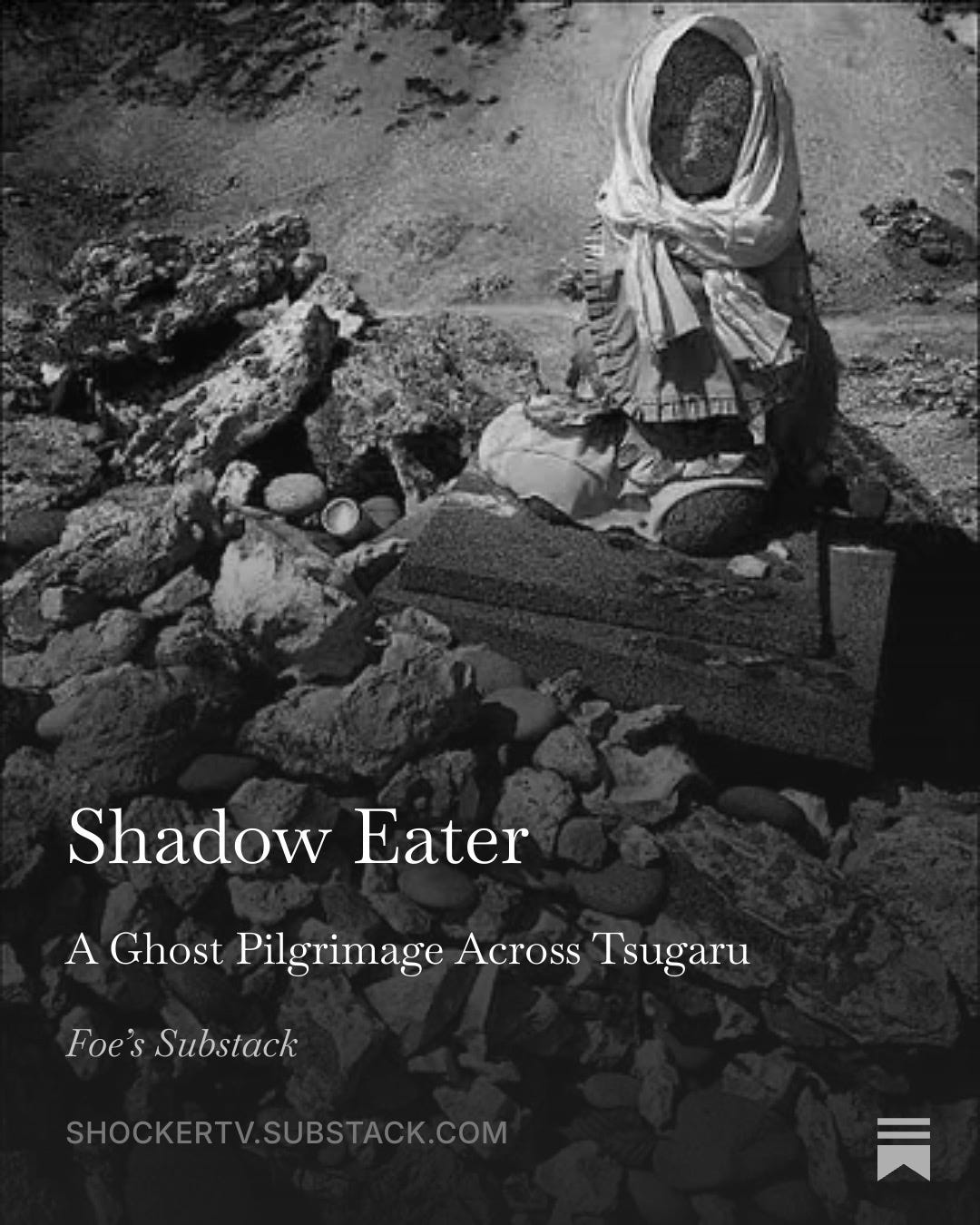
Chapter One: The Mountain Shadow to the South — Toward O-Iwaki-sama
It was the night I came back to Aomori that my father showed up in my dream.
Or, to be precise, “a shadow that resembled my father.” In all his living years the man had never once entered a dream of mine, so at first I didn’t even notice him.
The dream was set in a Japanese house, strangely nostalgic. But it matched no house that actually exists. My childhood home, the run-down apartment from my university days, the suburban house where I’d lived in America, a relative’s place in Shimokita — all of them had been collaged together by someone who hadn’t even bothered to hide the seams. The floor was tatami, but the walls were American drywall, and for some reason an old fluorescent tube hung from the ceiling.
My two sons and I were staying in that house.
My eldest sat in a corner, silently reading, toppling a mountain of stacked books as he went. In that mountain was one oddly thick volume with a sand-colored jacket. The title, in big English letters: LAST DUST RIDER. On the cover, the most American of Western-movie cowboys, battered hat pulled low, sat astride a horse in a sandstorm.
I picked it up and flipped through. It smelled of ink. The smell of a book printed in America — and yet mixed into it, somehow, was the old-paper smell of a Shōwa-era lending library. A blend of scents that shouldn’t exist in this world.
The first page showed the cowboy riding through a dark desert. But in the corner of the page, someone had scrawled a strange note:
— This is the far edge of the Tsugaru Plain.
I laughed in spite of myself. “Who the hell localized this?” I muttered in English, but my sons didn’t react. I couldn’t even tell whether my voice had come out at all.
When I looked back at the page, a triangular mountain shadow had risen on the horizon behind the cowboy. Snow-capped, elegant, its ridgeline somehow feminine.
O-Iwaki-sama.
At that, the air in the room went cold. From behind me drifted the smell of cigarette smoke.
I turned, and there was the oshiire — the closet. Its sliding door stood half open, and inside, my mother’s old clothes were packed tight. The loud blouses of her youth, sweaters furred with pilling, a pale-lavender dress, scraps of kimono from my grandmother’s generation.
For no reason I could name, I flicked a cigarette butt into that closet. My hand moved before thought did.
The next instant, deep in the mound of cloth, an orange flame snapped alive.
“Yabe—!”
The shout that came out of me was English and Tsugaru tangled together. “Hey! Water! Mizu motte koi!”
My younger son, who’d been sprawled on the floor, came running with a cup, looking put-upon. Inside: a little lukewarm water.
Before I could say “More!” my hand moved on its own and flung that scant water at the heart of the fire. A hiss — juu — and black smoke climbed toward the ceiling. The flame sank down, as if disappointed.
The smell of scorched cloth, the smell of my mother’s old clothes, and a sweet smell like incense all mixed together. My chest tightened, suddenly.
Just then, the cup noodles my younger son had been warming on the stove went pshht. The lid peeled open by itself, and something black came squirming up from inside.
Moths.
Moths mixed into the steam, small ones and large ones, rising up from between the noodles as if being born there. Beating wings that hadn’t yet dried, they whirled madly through the room.
They dove at the stove’s flame and burned, crackling as they fell away charred. That smell mingled with the smell of burnt cloth, and it felt to me like the very smell of fate that runs in my family’s blood.
“Stop! Turn it off! Kese, kese!”
Frantic, I killed the stove and wet the floor down with water.
That was when it happened. A shadow fell across the back corridor.
The corridor was strangely long, and damp somehow. Cold air seeped through the gap in the fusuma, and in it, a black shadow wavered.
My father.
Still in the sweats he’d always worn before he died, he came tottering toward me. Back slightly bent, one leg dragging — but his footsteps made no sound. It looked as if his shadow alone fell on the floor ahead of him.
Partway down the corridor he stopped, and peered at me without a word. The angle of the light hid his face. But his eyes were the eyes of a child who had tried to say something, failed, and swallowed it.
“…Nanmo, shabenne no ka?” — You’re not going to say anything?
What came out of my mouth was not English, not standard Japanese, but the Tsugaru tongue, back after all this time.
There was no answer. Only the weight of that silence, strangely vivid.
In that instant, the dream cut out.
I woke to the dim ceiling of the guest room. In the corner my phone was glowing — a message from my mother.
The foundation you sent me was lovely. The hairdresser’s coming Monday. I’m feeling a little more like myself.
Reading it, something warmed and ached in my chest. I started to murmur “Good for you, Mom” — and what came out instead was:
“Egatta naa, honto.”
I hadn’t been back in Aomori long, but the words of this land — even when you pretend to have forgotten them, the body remembers.
I left home at nineteen, crossed to America, and for more than thirty years never once truly faced my father. When we spoke on the phone it was weather and work, nothing else. The music I made, the films, the fiction — not once did he say that’s good.
And yet —
Now that he’s dead, he suddenly walks into my dreams. Wordless, pacing the corridor, present at the scene of every small disaster.
It felt as if he were trying to convey, through silence alone, the words he could never say while he lived.
I glanced out the window, and there in the thin morning light a mountain shadow floated in the distance. From here it should have been impossible to see, and yet its ridgeline was strangely distinct.
O-Iwaki-sama.
The mother mountain, seated to the south, watching over Tsugaru. A Navajo friend of mine once told me:
“The southern mountain is the mountain of life. It is where harmony begins.”
Those words suddenly connected, deep in my chest. My southern mountain was never that sky-blue peak beyond the desert. It was the one that sat in quiet stillness at the end of the road home: Mount Iwaki.
From the hallway came my mother’s voice.
“I’m making coffee — black okay?”
“Yeah, black is fine. …No — wait. Satō chotto irete kero.” — Put in a little sugar for me, will you.
I laughed at myself, a little embarrassed. The American habits don’t fade easily, but the Tsugaru tongue comes right back.
When the smell of coffee drifted in, I felt my father’s shadow slip into view again, somewhere at the bottom of my heart.
— Go to the mountain shadow in the south. Go and see.
It was no one’s voice, and yet I heard it clearly.
I quietly opened the window and breathed in the new air. And I murmured, softly:
“…Itte miru be.” — Guess I’ll go.
It sounded like the noise of my own life beginning to move again.
Chapter Two: The Mountain Shadow to the West — The Muddy Torrent of Osorezan
The morning after my trip to Mount Iwaki, I felt a strange exhaustion still clinging to me.
Must be the dream, I thought at first, taking it lightly — but somewhere deep in my chest something kept stirring, restless, refusing to settle. The closet that had caught fire, the stove that sent the moths flying — for things that happened inside a dream, they carried an odd weight of the real. I couldn’t say with any confidence that it had truly been “a dream” at all.
Sipping my coffee, I said to my mother, “Osorezan sa itte miyō ga na” — thinking I might go out to Osorezan — and she stopped, chopsticks in midair, and gave me an exasperated look. “Whatever for?”
Fair enough. I didn’t really understand why I was going either. But somewhere deep in my body, something was saying you must go. It was, I suppose, the “next stage” — the one that comes after you’ve seen O-Iwaki-sama.
I finished breakfast and boarded the bus. Local old folks murmured among themselves. Ordinary, everyday talk, all of it — and yet to my ears every word sounded like an omen. The wind’s been changing. The snow was light this year. Idle chatter, nothing more, but it might as well have been the password at the gates of Osorezan.
Outside the window, an overcast sky. Snow still lingered along the roadside, drinking in black mud, waiting for spring. The bus climbed the slope slowly, pressing deeper and deeper into the Shimokita Peninsula.
Then, suddenly, my father’s figure appeared in the bus window. On the verge of collapse. Only half his face, peering in at an angle that belonged to some parallel world.
“Just fatigue. Jet lag,” I told myself in English. But deep in my chest another voice whispered:
— He’s come again.
— Today you enter the western shadow.
Whose voice it was, I couldn’t begin to say.
When the main gate of Osorezan came into view, reality seemed to thin by one layer. That ground of white sand — no matter how many times you see it, it blurs the border with the “real.” The lake was still and transparent, and yet down at the bottom, murky shadows seemed to writhe.
That’s the color of the torrent in my dream, I thought.
The dream of the great flooding of the Tanabu River. The mud-water that had swallowed me the night before. The building along the bank, like a funeral hall. My mother pulled under by the current, and me struggling desperately to drag her out — that nightmare.
The Tanabu River — I’d heard about it on the news since childhood, the flooding, the overflows. And yet the water I saw in the dream was blacker, heavier, than anything real.
As I stared at the lake’s surface, my vision flickered and switched — and the lake before me began to turn, just like that, into a flow of mud.
“Stop. Snap out of it.”
I said it to myself, but the outline of reality did not come back.
Along the lake’s edge, Jizō statues stood strung together like beads on a rosary. Their black shadows overlapped with the shadow of my father, standing on the bridge pier above the Tanabu River.
— Did he tell me to save her?
— No. He only watched, in silence.
The memory of the dream seeped slowly outward from inside my chest. That dream was no mere dream. It was a notice sent from the world of the shadow-souls — I knew it by instinct.
In front of one of the huts at Osorezan, a young attendant called out to me.
“Um… the kuchiyose — the calling-down of the dead — there’s an opening, if you’d like.”
His tone was as natural as if he were offering me an appointment at the ear-nose-throat clinic.
Before I knew it, I was sitting on the tatami. The itako was still young, and she began chanting her invocation in a steady voice. Half the words escaped me, but the rhythm and swell of the sound wrapped itself around something deep in my chest.
“Recite, in your heart, the name of the one you wish to call.”
I didn’t need to summon up my father’s full name. Oyaji — Pop — was enough.
Silence held for a while; the only sound was the wind rattling the wooden door. Then, from deep in the itako’s throat, a sound rose up that resembled my father’s voice.
“Ome… oyoide da na.” — You… you were swimming.
In that instant, ice water ran down my spine. The cold of the Tanabu torrent came flooding back all at once, from my ankles up to my heart.
My breath caught.
“Tasukeyō to shite datta… kāchcha o…” — I was trying to save her… Mom…
I must have said it. The voice coming out of my mouth sounded like someone else’s.
It was supposed to be a dream I was describing — and yet the moment the words left me, the weight of that mud-flow sank into my chest like a thing that had really happened.
“Koko wa dogo nanda?” — Where is this? — I found myself saying aloud. “The Tanabu River, or Osorezan… I can’t tell anymore.”
The itako’s face contorted. Her voice trembled, and the trembling traveled straight into my chest.
“Kotoba… motte ne no da.” — He carries… no words.
That one utterance seemed to resound as if from the bottom of the lake. Whether it was my father speaking, or something else entirely, the sound refused to be pinned down.
“Who doesn’t? Pop?”
When I asked, silence fell again.
A strange stretch of time: silence, and yet the meaning came through with perfect clarity. Then that stone-like voice opened its mouth once more.
“After death, you see… words are too heavy. They are tools for the living only. A shadow-soul cannot carry them.”
In that instant I remembered my father’s figure on the bridge pier, looking down at the torrent. He hadn’t made a sound then. He had only watched.
Because he could carry no words.
“Then what does he keep showing up for?” I said. There was irritation mixed into my voice, I think. The exact voice of my childhood defiance.
After he died, my father began appearing in my dreams constantly. In more than twenty years in America, he hadn’t shown up once. And now, at this late date, he comes walking toward me night after night, saying nothing.
My father never acknowledged me while he lived. I made music, I wrote, I made films — and it always ended with a flat hmph. “You think you can eat on that?” “Get a normal job.” A man who seemed to have finished out his whole life on those two lines alone.
And yet, now that he’s dead, suddenly he comes drawing near. What kind of clumsy behavior is that? What kind of miserable timing is that?
The moment I thought it, everything dammed up in my chest burst out.
“Is he… is he looking at my life and feeling regret, is that it?”
The itako’s eyelids quivered. As if that question alone were the one the shadow-soul had not wanted to answer.
The silence sank deeper. The air in the room seemed to gain gravity, pressing down and down.
At last, the voice came.
“Regret, apology… a shadow-soul can do neither. It can only… follow. And him… he never once left your back. Not once.”
I lost my words. My mouth opened to say fuzakeru na — don’t give me that — but no sound came out.
In my mind’s eye rose the image of my father in the dream, tottering toward me. That back of his — it truly was like a shadow that follows. Not a strong father. Not a stubborn father. Just the shadow of a father who could carry no words, watching over his son, clumsy to the end.
After a while, the kuchiyose ended. On my way out, the moment I breathed the outside air, the torrent inside me seemed to still, just a little.
The lake was transparent, the sky white, the wind cold. An ordinary Osorezan landscape — and yet the sound of the mud-flow still lingered in me.
Looking at the row of Jizō, I lit a cigarette. Watching the flame, yesterday’s closet fire and the crackle of the burning moths all joined together in my chest as a single image. I hurriedly put it out, pressing the cigarette into the sand.
On the bus, my face reflected in the window looked somehow worn. And over the outline of that face, I thought I saw my father’s shadow overlap, just slightly.
“Don’t get sentimental,” I tried to wave it off in English — but what remained deep in my chest was a whisper in the Tsugaru tongue.
— The western mountain shadow is your own shadow.
— Nishi no yamakage wa, ome no kage sono mono da. Kore o koede ganeba, saki e ikarene. — Unless you cross it, there is no going forward.
The moment I left Osorezan behind, I had the feeling that the third mountain — Hakkōda — was already waiting for me, its shadow just around the next bend.
Chapter Three: The Mountain Shadow to the East — The White Mists of Hakkōda and the False Shadow
The night I came back from Osorezan, I could barely sleep.
Even with the room dark, the shadow reflected on the lake’s surface stayed burned into the backs of my eyes and would not leave. The weight of my mother’s arm sinking into the torrent, my father’s silence — they clung to the inner walls of my body like something pasted there.
Every time I turned over, the old house’s ceiling creaked. The wind outside was faint, and yet from somewhere far off came a murmuring, like fog pressing in.
“Fog rolling in.”
The weather-forecast phrase I’d heard a hundred times in America rose up in me. But this was no meteorology. It was the sign of a fog climbing up from inside my own chest.
And before I knew it, I was inside the dream.
The place was Grandma Kudō’s house. The old wooden house I used to visit on summer holidays as a child. The corridor absurdly long, and in the garden beyond the veranda, thin shadows swaying.
Grandma stood in the kitchen in her usual black kappōgi apron. But something was off. Her movements were slow and heavy, as if she were underwater.
“Grandma,” I called, and her back gave a small twitch. The face that slowly turned toward me was flat, like something folded from paper. As if someone had hastily pasted a person into the dream.
“Kaette kitan da ga…” — So you’ve come home…
She said it, but her voice was sucked into the wall almost at once.
When I left the house, I forgot my precious suitcase, left it sitting in the room. By the time I realized, it was already evening outside, the sky stained purple.
I have to go back, I thought, and turned — but the house was collapsing at its edges, half dissolved into the fog. Whether that was because it was a dream, or because the shape of memory itself was changing, I couldn’t judge.
Next thing I knew, I was standing in front of Hirosaki Station, where I’d gone to high school. Why here, of all places — I had no idea. New apartment blocks and a supermarket lined the rotary now; high schoolers in uniform, families heading home with their shopping, young people with faces like mine used to be, coming and going. I suppose I passed something like a youth around here too — and the moment I thought it, a chill touched my chest.
My shadow appeared in the glass of the station building. And I froze.
The shadow was following my movements one beat late. And the outline of its face was subtly wrong. Thinner somehow, longer, the eyes clouded like black puddles of standing water.
“…Nise-kage da.” — A false shadow.
The instant I said it aloud, my back went cold. What my Navajo friend had told me about the “false shadow” surfaced in my mind. The thing that draws close to the living, mimics their shadow, and devours the true one.
I stepped back without thinking. At that, the false shadow stretched — a slick, boneless extension — and slid toward my feet.
“No… no no no… stay away… Hanarero…!”
The shadow rippled like disturbed water. In the next moment the noise of the station front went silent all at once, and in its place, someone’s weeping rang out.
I turned, and there stood Kenta — my best friend growing up — and his older brother. Both in black clothes, both strangely solemn.
“Ome, chōdo ii tokoro sa kita na,” Kenta said. — Good timing, you showing up. “We’re going to visit Dad’s grave. Come on.”
In the dream, Kenta’s father was already dead. In reality he should still be alive — but inside the dream, the two of them spoke on that premise as if it were the most natural thing in the world.
I let myself be carried along behind them. We turned off the station front into a narrow alley, and the scenery changed abruptly into a graveyard. The smell of stone and the smell of incense mingled, and somewhere, someone was sniffling through tears.
Kenta’s brother held out his phone. “Koko ni kōden o haratte kero” — Pay the condolence money here.
On the screen, a strange app was open. Digital Kōden Payment, it said — no such service exists, I’d never heard of it. While I hesitated, my hand moved on its own and tapped the screen.
Ping.
“…Ome, harau gaku, keta machigederu zo.” — You got the digits wrong. By a whole place.
Kenta’s voice was flat with disbelief. The screen showed an enormous sum, already sent.
“Huh—? Wait, what!?”
My voice came out muddied, English and Tsugaru tangled together. In the seat beside me, a man I didn’t know began to sob, openly, loudly. As his weeping shook the air, the white fog spread again.
When I came to, the graveyard was gone and I was back in front of Hirosaki Station. Only the figure of the weeping man remained, in the middle of the rotary. Face buried in his hands, he was repeating, through his tears:
“Kaese… kaese…” — Give it back… give it back…
But what it was that I was supposed to return, I couldn’t tell.
Then a cold wind blew against my back. I turned, and the false shadow had returned to my feet. Denser than before, its outline sharper.
The shadow reached to seize my leg.
“Yamere!” — Stop it!
I shook it off hard, the shadow scattered like smoke, and in the next instant — I was awake on my futon.
My chest ached terribly. It wasn’t the feeling of having dreamed. It was the feeling of something having gotten inside.
My mother’s voice came from the hallway. “Hakkōda wa, mada yuki aru be. Igu no ga?” — There’ll still be snow on Hakkōda. You’re really going?
Yes. Today, where I was headed was Mount Hakkōda.
The eastern mountain shadow. The mountain of beginnings. The mountain where shadows change their shape.
When I stepped outside, the sky was a thin white — cloud or fog, impossible to tell. As I drove, the road grew more and more winding, snowmelt running along the shoulder.
The closer I came to the mountain, the more slowly the landscape drained of color. Trees that had been green turned gray, the edges of the road blurred, and the whole world became like a sketch drawn on white paper.
Hakkōda. Where death and life cross; where untold numbers of the lost sank into the snow. This is the mountain where shadows begin — I had the feeling I’d heard that somewhere.
The moment I entered the mountain road, the fog thickened. Beyond the windshield, pure white — the sensation of driving through open air.
“…Koko, honto ni michi dabe ga…?”
“Is this even a road…?” I added in English. In neither language did an answer come.
I stopped the car and got out, and the fog came touching my skin. It should have been cold, but it was strangely warm. As if the fog itself were breathing.
When I began to walk, the shadow at my feet wavered. It should have been my own shadow, cast on the road — but the shape was wrong.
The shoulders were broader than mine. The arms longer. The stride didn’t match.
“…Mata ka.” — Again.
The false shadow from yesterday was here too, pressed close to me. In the fog it grew denser and denser, until it stood beside me at my own height.
And then the shadow opened its mouth.
— Kaese. — Give it back.
The voice resembled the weeping man at the station. No — it resembled my father’s voice too. And somewhere in it, it resembled my own.
“What… give what back?”
The shadow didn’t answer. Instead the fog thickened and took my sight.
From deep in the fog, the corridor of my grandmother’s house emerged. And at the end of that corridor stood Grandma Kudō. Her face still flat as folded paper, only the eyes like black holes.
“Kaette kitan da ga…”
Her voice echoed through the fog.
Beyond the fusuma, the suitcase sat waiting. Mine. The precious luggage I had left behind — in reality, in dreams, all along.
The moment I reached for it, the sound of the wind changed. The fog stirred and rustled, and I heard the sound of someone falling.
That sound… it was the sound of my father staggering and going down.
Collapsing in the park, over and over, and each time hauling only his consciousness back up, rising as if to insist — I’m still alive. That figure of his.
“…Nande da yo.” — Why.
The voice leaked out of me on its own.
“Why did you never once come into my dreams while you were alive — and now that you’re dead, you won’t stay out of them…”
The answer came from inside the fog.
— A shadow, while its man lives, cannot come out unless it is called.
“I never called you.”
— You called.
“Yonde nē!” — I did not call!
The fog of Hakkōda began to thin, and in its place, everything dissolved — Grandma Kudō’s house, the station front at Hirosaki, the kōden payment screen, the false shadow, all of it melting away.
What remained in the fog was one thing only.
The shadow of my father, on the verge of falling.
He turned his face toward me. Only half of it was visible. But that half was the same as the shadow that had looked down at me from above the torrent, that time.
— Next is the north.
When the fog cleared completely, I was standing in the middle of the Hakkōda mountain road. At my feet lay a single shadow — my own. The false shadow was gone.
But deep in my chest, my father’s voice remained.
— At the northern mountain shadow, the shadow takes its true form.
Mount Kamafuse. The far end of Shimokita. The place where the shadow-souls go last.
Descending the mountain slowly, I thought:
Having come this far, there’s no running anymore. The meaning of my father’s silence… at last, I will have to hear it.
Chapter Four: The Mountain Shadow to the North — Mount Kamafuse, the Core of the Shadow-Soul, and My Father’s Fear
The night I came out of the Hakkōda fog, I lay in my futon for hours, eyes shut, unable to move.
Deep in my chest, something like a wet stone was sinking, dragging, with a slow grinding sound. Not the heart. Not the lungs. Deeper — a thing that will not peel away, stuck fast to the floor of the shadow-soul.
The words I’d heard at Osorezan turned over and over in me.
— And him… he never once left your back. Not once.
No. That can’t be right. While he lived, my father avoided me like a man in flight. When I talked about the music I loved: “Wagarane.” — I don’t get it. When I showed him a picture I’d drawn: “So what.” When I recommended a book: “Kimiwarī.” — Creepy.
I heard it from my mother, later. Apparently my father had said this, and meant it:
“If that boy stays in Aomori, he’ll end up a murderer — or the founder of some weird religious cult.”
It was fear. A helpless, bottomless fear of a son he could not understand.
That fear was the true face of his silence. No — the silence was the result of the fear. Never its resolution.
The next morning, as I got ready to head for Mount Kamafuse, a raw ache pulsed deep in my chest. As if something were gnawing at me from the inside.
On the way, the moment I saw the black water of the Tanabu River, the torrent from that dream struck me through the crown of the skull. The weight of my mother’s arm. Her back, going under. The feel of her sleeve, gripped and then sliding away through the mud, slick and gone.
“Calm down. It’s just a river.”
I whispered it in English, but the shadow of the torrent stayed clinging to the riverbed and would not let go.
By the time I reached the foot of Kamafuse, the world was cold in the way of a thing with one layer of skin peeled off. The shadows of the trees were too black — midday, and yet it was like the floor of the night.
The instant I stepped out of the car, the shadow at my feet trembled. Not the wind. What was trembling was the shadow itself.
“…Mō nigerarene na.” — No running now.
As I climbed, the color drained out of the landscape. The birds’ voices vanished; only the sound of snowmelt ran close by, though the water itself was nowhere to be seen.
Ahead of me, a black shadow swayed. Not a tree. Not a rock.
That thing — was standing.
A rounded back, the outline of a dragging leg. My father’s shadow-soul.
Denser than the one I’d seen at Hakkōda, its form sharper — and yet only half its face existed.
That half-face’s eye looked at me. No — not looked. It peered in.
In the mountain’s stillness, only my voice was swallowed up.
“…Why did you avoid me like that?”
The shadow didn’t answer. Its silence was colder than the wind.
“You were afraid of me. Weren’t you.”
The shadow gave a small convulsive sway. A tremor of assent.
“The books I read, the music, all of it — you thought you’d never understand any of it. Didn’t you.”
The shadow began to seep toward me, slow and gradual. Not on legs. It moved the way a shadow draws near.
My heart pounded. Not my head — my gut, my organs, stirring.
— What cannot be understood is to be feared. — You are broken. — You defile the house. — You cloud the bloodline.
It wasn’t a voice. The meaning drove straight into my chest, unmediated. A shadow-soul does not “speak” in sound. It speaks in the pressure of its existence.
Not anger. Not grief. Something wordless — a cold, finished resignation — spread through my chest.
“Oyaji… ora ga sonna ni kowagatta no ga.” — Pop… was I really that terrifying to you?
No answer. Only, where it stood, the shadow took one step — toward me.
Further up the mountain path, my field of vision suddenly tore open.
It should have been the summit. Instead, the muddy torrent of the Tanabu River filled everything.
Impossible. And yet the water was there. The border between dream and reality had died.
My father’s shadow stood before the torrent.
The same as that day. Not trying to save her. Not reaching out a hand. Only watching.
“…Was the part of me that seemed about to break really so frightening to you?”
My words shook.
The shadow seemed to nod. My father had believed I was broken. All his life. When I went to America. When I came back.
He believed, in earnest, that I would become the family’s shame. That merely looking at me made his heart crawl — he was that afraid.
I stepped forward into the torrent. There was no cold. Only a bottomless darkness, spreading.
“…Wagatta.” — I understand now. “You couldn’t understand me, couldn’t love me, couldn’t come near me. That was the real reason. Wasn’t it.”
The wind stopped. The sound of the world went out.
The shadow bled toward me. Not slowly — the way a thing is drawn in.
“Wait… Oyaji…”
The shadow was trying to lay itself over mine. Not healing. Not integration. This was — invasion.
I tried to run, and my legs wouldn’t move. It wasn’t the water of the torrent. My own shadow was gripping my feet.
My father’s shadow pressed in as far as my chest. No light. Only a cold weight, sinking down into me.
— If you break, then I am saved. — And so I will break you.
In that instant, I understood. My father had never sought reconciliation. Not apology, not understanding, not closeness. He had come for one thing only —
To transfer his shadow. Onto me.
The shadow entered deep into my chest. No searing pain, no cold like ice. Only, quietly, matter-of-factly, it built its nest inside my shadow.
I couldn’t breathe. I tried to scream and no voice came.
My vision blurred black.
I saw my father’s eyes. Those eyes, wet with fear.
— This is right. — Now suffer, all the days that you live.
The moment the shadows lay perfectly one over the other, the world went quiet.
No light, no wind, no sound. Only, inside my own shadow, another shadow had taken up residence.
There was no father’s face in it. Only a fear that will never fade — that alone was left behind.
The shadow at my feet — I could no longer tell mine from my father’s. Which was whose, no longer possible to say.
Coming down the mountain, I noticed it.
Deep in my chest, a voice is laughing.
Not my voice. Not my father’s voice, either.
The voice of the shadow itself.
The wind of Kamafuse blows, and the shadow sways, faintly.
But it is no longer a shadow belonging to me alone.
No running now. No one will save me. Kamafuse fed me the shadow — made me swallow it whole.
And I have no choice but to go on living inside it.
— Shimai da. — It is finished.