
The Blenheim Crescent Terminal
A Chronicle of Vanished Frequencies

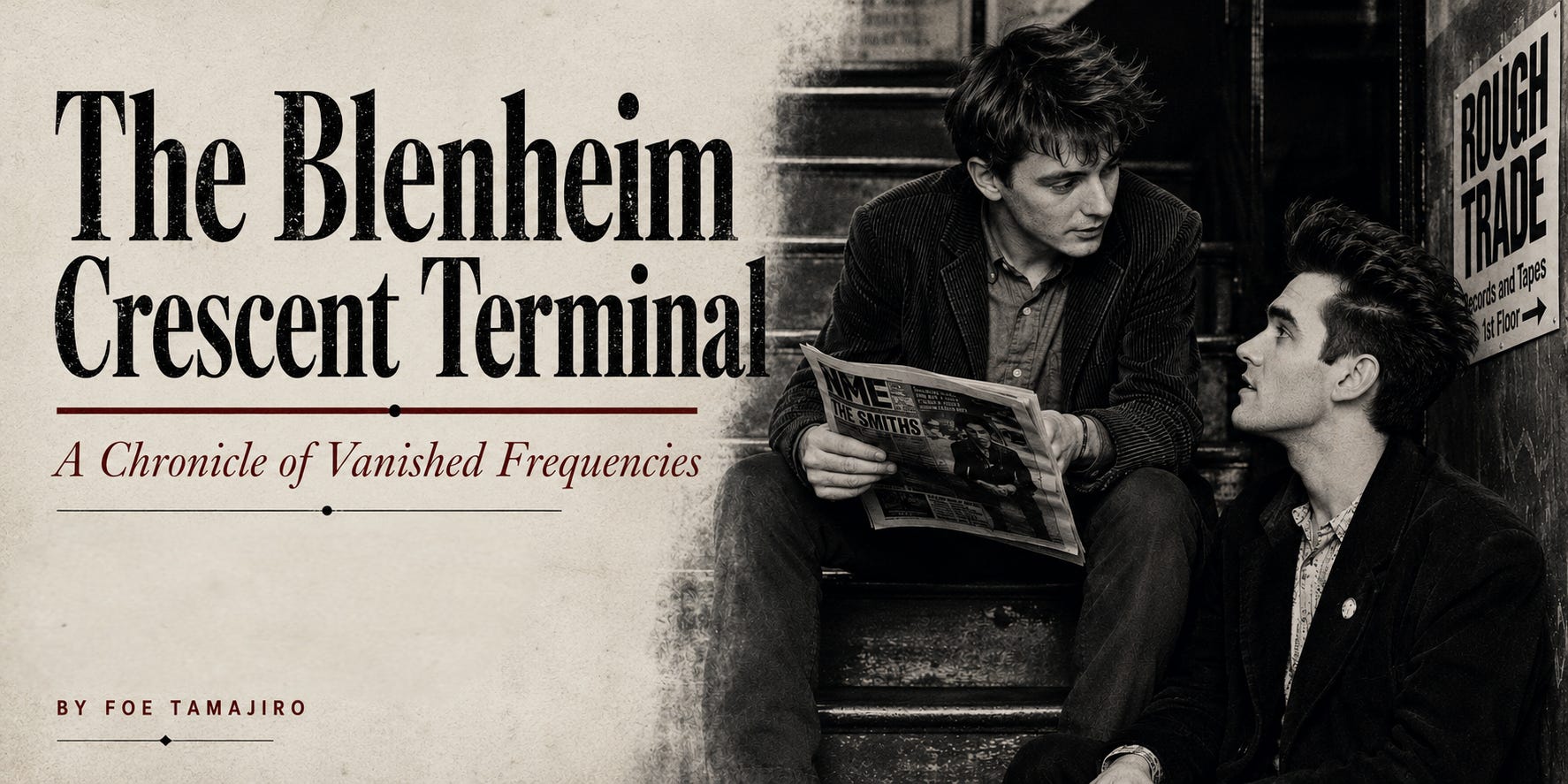
Later, when all of it had collapsed — the co-operative, the distribution network, the entire postal system of seven-inch singles that for a few years had constituted an alternative infrastructure across the British Isles — it would be possible to reconstruct, with some precision, the afternoon in early December 1983 when two young men sat across from each other in a café near the Rough Trade offices at Blenheim Crescent, W11, and failed to prevent anything.
The offices occupied the first floor of a building whose ground-level function shifted seasonally between junk retail and temporary abandonment. Geoff Travis, the Cambridge-educated proprietor who had sold his stake in the shop the previous December but retained control of the label, ran the operation according to principles derived equally from Trotskyist collective bargaining and an intuitive curatorial instinct that he could not have explained to anyone, least of all himself. The staff were paid identically. The heating was unreliable. Unsold copies of Augustus Pablo’s “King Tubby Meets Rockers Uptown“ served as doorstops. It was, in the parlance of the period, independent.
Roddy Frame had come down from a borrowed flat in Earls Court to collect a royalty statement. He was nineteen years old. His debut album, “High Land, Hard Rain“, released the previous April, had reached number twenty-two on the UK chart — a remarkable performance for a record assembled largely from songs composed by a teenager in East Kilbride who cited Cole Porter and the Flamingos alongside the Buzzcocks. Elvis Costello had publicly declared himself frightened of the boy. The NME had called him a genius, which in that newspaper’s economy of attention meant he had approximately nine months before they would call him something else. He was aware of this schedule. He wore a corduroy jacket that did not fit him and carried a paperback — Borges, or possibly John Fante, accounts differ — whose spine was so broken it had separated into two halves held together by the pressure of his coat pocket. He had the air of someone waiting for a bus that might or might not arrive and that might or might not be going where he needed.
He was, in fact, waiting for Travis, who was upstairs on the telephone to a pressing plant in Hayes, Middlesex, attempting to resolve a dispute about a François Kevorkian remix of a single called “This Charming Man” that Rough Trade had distributed more widely than either the singer or the guitarist of the band in question had authorised. The singer was twenty-four. His name was Steven Patrick Morrissey. He arrived at Blenheim Crescent at approximately three o’clock in the afternoon, though he would later recall it as dusk, because Morrissey experienced all of 1983 as a kind of gathering twilight — the last grey weeks before the lights, whatever they were, came on.
They had met before. A television green room in Manchester, possibly for “The Tube“, possibly for a regional programme nobody recorded. Frame remembered Morrissey’s handshake as unexpectedly firm. Morrissey remembered Frame’s guitar case, which had stickers on it from venues in New York — the Danceteria, where Aztec Camera had played that summer — and which seemed to Morrissey an almost obscene display of cosmopolitanism. Morrissey in 1983 had barely left England. He had left Manchester only under duress. The world outside his bedroom at 384 Kings Road, Stretford, came to him through the letter box: records, fanzines, the NME, letters from pen-pals who did not know they were pen-pals. He had constructed an entire aesthetic — one that would shortly restructure British popular culture — from the raw materials of a Mancunian childhood so cloistered it resembled a laboratory experiment in sensory deprivation, an experiment whose results, against all probability, were Oscar Wilde, the New York Dolls, and a singing voice that made grown men in Whalley Range weep into their lager.
Frame was sitting on the stairs when Morrissey came through the door. The stairs at Blenheim Crescent were narrow, uncarpeted, and functioned as the label’s informal waiting room, reading room, and confessional. Anyone who had business with Rough Trade eventually sat on those stairs. Frame was reading an NME in which the Smiths featured prominently. He looked up. Morrissey looked down. There was a half-second of navigational awkwardness — someone would have to move — and in that half-second something happened that neither of them would have been able to articulate and that, in any case, is not the sort of thing that belongs in a factual account.
What “can“ be said is that Morrissey sat down on the step below Frame, which placed his head at the level of Frame’s chest, and said something about the NME piece. The remark was self-deprecating in the way that only a statement of absolute confidence can be: he noted that the photograph made him look consumptive, which he appeared to regard as a compliment the photographer had not intended. Frame laughed. It was an easy laugh, unguarded. He had not yet learned to protect himself from other people’s charm.
“I think ‘This Charming Man’ is a perfect single,” Frame said.
He meant it. He had heard the John Peel session recording in September and recognised immediately what Johnny Marr had done: taken the ringing, Byrds-inflected guitar architecture of “Oblivious” — Frame’s own single, the one that had threatened to give Rough Trade its first proper hit — and rebuilt it in a different key, a different city, with a vocalist who sounded nothing like anyone on earth. Frame was not offended by this. He understood musical theft the way a jazz musician understands it: as the sincerest form of listening. What Marr had stolen, he had improved. Frame knew this. It was, in its way, the loneliest knowledge he had ever possessed.
Morrissey received the compliment by returning it. He said something about Frame’s guitar playing that involved the word “indecent” — “indecently accomplished“, or “indecently good for someone your age“, the precise formulation lost now in the four decades of accumulated interview transcripts and biographies that have since silted over the actual past like alluvial deposits over a drowned settlement. What survived was the tone: an older-brotherly admiration delivered with the faintest edge of a challenge, as if Morrissey were daring Frame to accept the praise without blushing. Frame
Travis was still on the telephone. The pressing plant in Hayes was experiencing what it described as a “scheduling conflict,” which in practice meant that the Kevorkian remix, already pressed in limited quantities for New York club DJs, had been given wide UK distribution on Travis’s instruction and was now selling in numbers that neither the singer nor the guitarist had anticipated or desired. Morrissey, who had publicly disowned the remix and urged fans not to buy it, did not yet know that Travis had authorised the distribution. He would find out later that week. The resulting argument would establish a pattern — Morrissey’s will against Travis’s pragmatism — that would repeat, with escalating bitterness, for the next four years, until the label and the band destroyed each other with the thoroughness of binary stars collapsing into a shared gravity well.
But that was later. That afternoon, with Travis occupied and the December light fading over the rooftops of Notting Hill, Frame and Morrissey walked to a café across the road. It was not a café either of them would have chosen. The tea was institutional. The Formica tables had the particular grimness of surfaces cleaned so often they had become indistinguishable from dirt. A radio was playing, quietly, something by Paul Young.
Frame talked about his band. There was, by December 1983, very little band left to talk about. The original lineup had atomised in the way that bands fronted by nineteen-year-old prodigies inevitably atomise: the others couldn’t keep up, or didn’t want to, or discovered that democracy was incompatible with genius. Craig Gannon, a sixteen-year-old guitarist from Salford who had answered an advert in “Melody Maker“ at the start of the year, was the latest addition, and would leave within months. Later — in 1986, in one of those biographical rhymes that make pop history feel scripted by a novelist with an over-developed sense of irony — Gannon would join the Smiths as their fifth member, briefly bridging the two bands like a ligament connecting bones that had never been part of the same skeleton.
Frame described the disintegration without self-pity. He had learned, already, at nineteen, that a band is a fiction maintained by mutual consent, and that when the consent withdraws the fiction does not gradually fade but simply stops, like a television switched off: not darkness but the absence of the thing that had been light. Morrissey listened with the attention of a man memorising a map of territory he would eventually have to cross himself.
“What’s it like,” Morrissey asked, “to be the only one?”
“You’d know,” Frame said.
This was more perceptive than Frame perhaps realised. Morrissey, in December 1983, was already functionally alone within the Smiths, in the sense that the band was a vehicle for a sensibility — his — that could not have been produced by collaboration and that collaboration could only dilute. Johnny Marr was essential, irreplaceable, the only musician alive who could translate Morrissey’s references into sound, but Marr was essential the way a lens is essential to a projector: without it, the image cannot reach the wall, but the image does not originate in the lens. Morrissey knew this. Marr, at twenty, was only beginning to suspect it. The suspicion would take three and a half years to mature into certainty, and the certainty would kill the band as efficiently as a bullet.
Frame asked about Marr. Morrissey’s response was reverent. He used the word “extraordinary.” He said that Marr heard things in songs that no one else heard — ghost melodies, structures beneath structures. He said that the afternoon Marr had walked into the Rough Trade offices on Blenheim Crescent the previous spring, grabbed Geoff Travis by the arm, and demanded he listen to the demo of “Hand in Glove,” was the afternoon the future had begun. He said this with the absolute conviction of someone who believed that history was not a process but an event — that it didn’t accumulate but detonated, and that he had been standing at the detonation point with his hand on the fuse.
Then he said: “I worry, sometimes, about what happens when he realises.”
“Realises what?” Frame asked.
Morrissey stirred his tea. The spoon made a sound against the cup that, in the silence of the café, seemed unreasonably precise.
“That he doesn’t need me,” Morrissey said. “That anyone can sing.”
Frame, who knew that this was exactly wrong — that Morrissey’s voice was the least replaceable element of the entire enterprise, more distinctive than Marr’s guitar, more essential than the songs — said nothing, because he understood that Morrissey was not expressing a fear but rehearsing one, the way an actor rehearses a death scene, and that to contradict him would be to interrupt the performance.
The conversation arrived, eventually, at the question that mattered to both of them, though neither had introduced it.
Rough Trade, or a major label.
Frame was leaving. This was not yet public knowledge, but it was understood within the building at Blenheim Crescent with the resigned clarity of a diagnosis. He would sign with WEA — Warner’s — within months. The next album, “Knife“, would be produced by Mark Knopfler of Dire Straits, a fact so improbable that when Frame mentioned it Morrissey’s expression underwent a sequence of adjustments that began with disbelief, passed through amusement, and settled on something close to grief.
“Knopfler,” Morrissey repeated, as if tasting the word for toxins.
Frame explained. He had been living in New Orleans — another detail that seemed, to Morrissey, to belong to someone else’s life, a life conducted in colour while his own played out in the silvery monochrome of Manchester rain — and had been listening to Bob Dylan’s “Infidels“, which Knopfler had produced. He wanted that sound. He wanted a proper recording budget, proper distribution, the chance to reach people who would never walk into a Rough Trade shop. He framed it as pragmatism. He was eighteen when he signed the deal. He did not know, because no one had explained to him, that the contract gave the label ownership of his recordings in perpetuity. He would not discover this for thirty years.
Morrissey was appalled. Or performed appalledness, which in Morrissey’s case was a distinction without a difference, since his emotions and his performances of emotion had long since fused into a single indivisible substance, like an alloy. For Morrissey, the independent label was not a business arrangement but a moral position. To be on Rough Trade was to be “against“ something — the machinery of corporate pop, the alliance of marketing and mediocrity that had produced the current chart, in which “This Charming Man” sat at number twenty-five like a spy behind enemy lines, surrounded by Tina Turner, the Thompson Twins, and a Culture Club single whose video Morrissey had described, in a recent interview, as “a war crime against the senses.”
To leave Rough Trade was to surrender. It was to admit that the music was a product, that the audience was a market, that the revolution — whatever revolution they had been conducting from the upper floors of buildings in Notting Hill and the back rooms of pubs in Moss Side — was over.
Frame pushed back, gently. “Isn’t refusing a wider audience its own kind of vanity?”
Morrissey looked at him. The café was darker now. Outside, Blenheim Crescent was acquiring the particular desolation of a London side street in early December: the sodium lights coming on, the pavements emptying, the Georgian facades turning the colour of old teeth. The radio had moved on from Paul Young to something by Kajagoogoo, which neither of them acknowledged, as if acknowledging it would have been a form of defeat.
“Vanity,” Morrissey said, “is the only thing that distinguishes us from furniture.”
This was a line. Frame recognised it as a line — possibly adapted from Wilde, possibly invented on the spot, the seam between quotation and origination in Morrissey’s speech being as invisible as the seam between sincerity and performance — and he admired it, and he resented it slightly, because it closed down the argument by being more memorable than any counterargument could be. This was Morrissey’s method, then and always: to win not by logic but by epigram, to replace the question with a sentence so perfectly shaped that the question seemed, retroactively, to have existed only in order to produce the sentence. It was a technique that worked brilliantly in interviews and lyrics and catastrophically in personal relationships, but Frame did not know this yet, and Morrissey, who did know it, could not have changed it if he had wanted to, which he did not.
They didn’t resolve it. They were never going to. The disagreement was not a disagreement but a prophecy: Frame would leave Rough Trade within months, sign with WEA, make increasingly polished records that the NME would regard as betrayals, and spend the next decade producing music of intermittent brilliance that reached a steadily diminishing audience, not because the music was worse but because the audience had moved on to the Smiths, who had replaced Aztec Camera on the Rough Trade roster as cleanly as one tenant replaces another in a rented flat, inheriting the same walls, the same view, the same damp patch in the corner that no one ever fixed.
Morrissey would stay. He would stay until staying became impossible — until the legal disputes and the royalty arguments and the catastrophic implosion of Rough Trade’s distribution arm in 1989 buried the label under debts that its cooperative principles had left it uniquely unequipped to manage. But by then the Smiths would already be dead, killed not by business but by the thing Frame had almost named that afternoon in the café: the moment when Marr realised. The moment when the lens understood that it was not the image. The moment when it walked away.
They parted outside the café. The afternoon was gone. Blenheim Crescent had achieved its final winter configuration: a street of closed doors and lit windows and the particular silence of a London neighbourhood that is not quiet but merely between sounds.
Morrissey turned north, toward Ladbroke Grove, where he would catch the Tube to Euston and then the train back to Manchester, back to Kings Road, Stretford, back to the bedroom where the New York Dolls poster and the Shelagh Delaney first editions and the Complete Works of Oscar Wilde — given to him by his mother at the age of eight with the instruction that it contained everything he needed to know about life — waited for him with the patience of objects that know they are more permanent than the people who own them.
Frame went back into the building. He climbed the stairs. He sat on the same step where he had been sitting an hour earlier and waited for Travis, who was still on the telephone. Through the window he could see the street. Morrissey’s coat — long, dark, an Oxfam overcoat of the kind that Morrissey would make so iconic that within two years every sixth-former in Britain would own one — was visible for a few seconds, moving north, and then it turned the corner and was gone.
Frame had the thought — not quite a premonition, more a disturbance in the frequency of the afternoon, a brief loss of signal — that they had just had the most important conversation either of them would have that year. He also had the thought that neither of them would remember it accurately. That what had actually been said would be replaced, in memory, by what should have been said, and that the should-have-been version would be more true and less real than whatever had actually occurred in the café with the Formica tables and the Kajagoogoo on the radio and the tea that tasted of nothing.
He was right. This is that version.
Blenheim Crescent continued to function as the headquarters of Rough Trade Records until 1984, when the label relocated to larger premises at Collier Street, Kings Cross. The building at Blenheim Crescent is now occupied by a shop selling artisanal sourdough. The café does not exist. Roddy Frame released his most recent solo album,“ Seven Dials, “in 2014. Morrissey published an autobiography in 2013 that did not mention Aztec Camera. The Formica tables were presumably discarded. Nothing else has changed.